Type-safe metadata container used throughout MsPASS. More...
#include <Metadata.h>
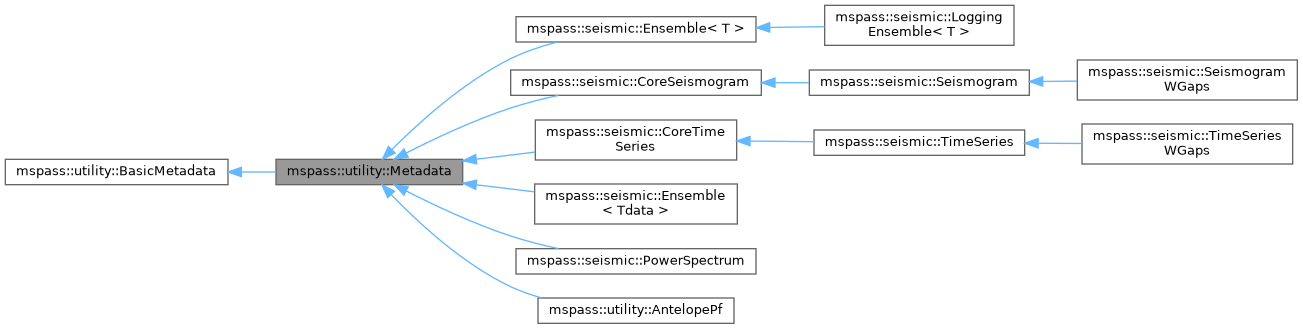
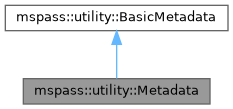
Public Member Functions | |
| Metadata () | |
| Metadata (std::ifstream &ifs, const std::string form=std::string("pf")) | |
| Metadata (const Metadata &mdold) | |
| virtual | ~Metadata () |
| Metadata & | operator= (const Metadata &mdold) |
| Metadata & | operator+= (const Metadata &rhs) noexcept |
| const Metadata | operator+ (const Metadata &other) const |
| double | get_double (const std::string key) const override |
| int | get_int (const std::string key) const override |
| long | get_long (const std::string key) const |
| std::string | get_string (const std::string key) const override |
| bool | get_bool (const std::string key) const override |
| template<typename T > | |
| T | get (const std::string key) const |
| template<typename T > | |
| T | get (const char *key) const |
| Generic get interface for C char array. | |
| boost::any | get_any (const std::string key) const |
| std::string | type (const std::string key) const |
| template<typename T > | |
| void | put (const std::string key, T val) noexcept |
| template<typename T > | |
| void | put (const char *key, T val) noexcept |
| void | put (const std::string key, const double val) override |
| void | put (const std::string key, const int val) override |
| void | put (const std::string key, const bool val) override |
| void | put (const std::string key, const std::string val) override |
| void | put (const char *key, const char *val) |
| void | put (std::string key, const char *val) |
| void | put_object (const std::string key, const pybind11::object val) |
| void | put_int (const std::string key, const int val) |
| void | put_string (const std::string key, const std::string val) |
| void | put_bool (const std::string key, const bool val) |
| void | put_double (const std::string key, const double val) |
| void | put_long (const std::string key, const long val) |
| void | append_chain (const std::string key, const std::string val, const std::string separator=std::string(":")) |
| std::set< std::string > | modified () const |
| void | clear_modified () |
| Mark all data as unmodified. | |
| std::set< std::string > | keys () const noexcept |
| bool | is_defined (const std::string key) const noexcept |
| void | erase (const std::string key) |
| std::size_t | size () const noexcept |
| std::map< std::string, boost::any >::const_iterator | begin () const noexcept |
| std::map< std::string, boost::any >::const_iterator | end () const noexcept |
| void | change_key (const std::string oldkey, const std::string newkey) |
| Change the keyword to access an attribute. | |
| template<> | |
| double | get (const std::string key) const |
| template<> | |
| int | get (const std::string key) const |
| template<> | |
| long | get (const std::string key) const |
| template<> | |
| bool | get (const std::string key) const |
| template<> | |
| float | get (const std::string key) const |
| template<> | |
| double | get (const string key) const |
| template<> | |
| int | get (const string key) const |
| template<> | |
| long | get (const string key) const |
| template<> | |
| bool | get (const string key) const |
| template<> | |
| float | get (const string key) const |
 Public Member Functions inherited from mspass::utility::BasicMetadata Public Member Functions inherited from mspass::utility::BasicMetadata | |
| virtual | ~BasicMetadata () |
Protected Attributes | |
| std::map< std::string, boost::any > | md |
| std::set< std::string > | changed_or_set |
Friends | |
| pybind11::object | serialize_metadata_py (const Metadata &md) |
| Metadata | restore_serialized_metadata_py (const pybind11::object &sd) |
| std::ostringstream & | operator<< (std::ostringstream &, const mspass::utility::Metadata &) |
Detailed Description
Type-safe metadata container used throughout MsPASS.
Metadata stores named scalar values in a boost::any map and provides typed accessors, serialization helpers, and merge/update operations for seismic data headers and processing state.
Constructor & Destructor Documentation
◆ Metadata() [1/3]
|
inline |
Default constructor. Does nothing.
◆ Metadata() [2/3]
| mspass::utility::Metadata::Metadata | ( | std::ifstream & | ifs, |
| const std::string | form = std::string("pf") |
||
| ) |
Construct from a file.
This simple file based constructor assumes the file contains only a set lines with this format: key value type where type must be one of: real, integer, bool, or string. Note int is actually always promoted to a long. The optional format variable is there to allow alternative formats in the future.
- Parameters
-
ifs ifstream from which to read data form optional format specification. Currently only default of "text" is accepted.
- Exceptions
-
MsPASSError can be thrown for a variety of conditions.
References changed_or_set, get(), and md.
◆ Metadata() [3/3]
Standard copy constructor.
- Parameters
-
mdold parent object to be copied
◆ ~Metadata()
|
inlinevirtual |
Destructor - has to be explicitly implemented and declared virtual for reasons found in textbooks and various web forums. A very subtle feature of C++ inheritance.
Member Function Documentation
◆ append_chain()
| void mspass::utility::Metadata::append_chain | ( | const std::string | key, |
| const std::string | val, | ||
| const std::string | separator = std::string(":") |
||
| ) |
Create or append to a chained string.
A chain conceptually is identical to a list of string data. We implement it in Metadata because sometimes (e.g. MongoDB interaction and some constructs like the unix shell PATH variable) handling a full scale container like list<std::string> would be awkward. If more extensive capability like that is needed it would be better to add a class that inherits Metadata and does so. AntelopePf more or less does this, for example, handling Tbl sections. In any case, this usage is more for one word strings separated by a common separator: e.g. path=/usr/local/bin:/bin uses : as the separator. /usr/local/bin and /bin are the chain.
If the key related to the chain does not yet exist it is silently created. If it already exists and we append to it.
- Parameters
-
key is the key that defines the string. val is the the new string to append to the chain separator is the string used for a separator (default ":")
- Exceptions
-
MsPASSError will be thrown if data is found in key and it is not of type string.
References changed_or_set, get(), get_string(), is_defined(), put(), and type().
◆ begin()
|
noexcept |
◆ change_key()
Change the keyword to access an attribute.
Sometimes it is useful to change the key used to access a particular piece of data. Doing so, for example, is one way to implement an alias (alternative name) for something. The entry for the old key is copied to a entry accessible by the new key. The entry for old is then deleted. This avoids downstream inconsistencies a the cost of possible failures from the translation. This method always returns and will silently do nothing if old is not defined. If the new key is already defined, its content will be replaced by the old's.
- Parameters
-
oldkey is the key to search for to be changed newkey is the new key to use for the replacement.
◆ clear_modified()
|
inline |
Mark all data as unmodified.
There are situations where it is necessary to clear the data structure used to mark changed metadata. The best example know is when data objects interact with a database and try to do updates. Effort can be wasted in unnecessary updates if metadata are improperly marked as modified. This method clears the entire container that defines changed data.
References changed_or_set.
◆ end()
|
noexcept |
◆ erase()
Overload for C string
Clear data associated with a particular key.
References changed_or_set, get(), and md.
◆ get() [1/12]
|
inline |
Generic get interface for C char array.
This is a generic interface most useful for template procedures
that need to get a Metadata component.   Since this object only
can contain simple types the type requested must be simple.
Currently supports only int, long, short, double, float, and string.
C char* is intentionally not supported. This is largely a wrapper
on the string key version of this same generic function.

\param key is the name tag of desired component.

\exception - will throw a MetadataGetError (child of MsPASSError) for
   type mismatch or in an overflow or underflow condition.
References get().
◆ get() [2/12]
| T mspass::utility::Metadata::get | ( | const std::string | key | ) | const |
Generic get interface.
This is a generic interface most useful for template procedures that need to get a Metadata component. Since this object only can contain simple types the type requested must be simple. Currently supports only int, long, short, double, float, and string. C char* is intentionally not supported. Calls to anything but the supported types will throw an exception.
- Parameters
-
key is the name tag of desired component.
- Exceptions
-
- will throw a MetadataGetError (child of MsPASSError) for type mismatch or in an overflow or underflow condition.
◆ get() [3/12]
| double mspass::utility::Metadata::get | ( | const std::string | key | ) | const |
Specialization of Metadata::get for double values.
◆ get() [4/12]
| int mspass::utility::Metadata::get | ( | const std::string | key | ) | const |
Specialization of Metadata::get for int values.
◆ get() [5/12]
| long mspass::utility::Metadata::get | ( | const std::string | key | ) | const |
Specialization of Metadata::get for long values.
◆ get() [6/12]
| bool mspass::utility::Metadata::get | ( | const std::string | key | ) | const |
Specialization of Metadata::get for bool values.
◆ get() [7/12]
| float mspass::utility::Metadata::get | ( | const std::string | key | ) | const |
Specialization of Metadata::get for float values.
◆ get() [8/12]
| double mspass::utility::Metadata::get | ( | const string | key | ) | const |
Specialization returning numeric metadata as a double.
References get_double().
◆ get() [9/12]
| int mspass::utility::Metadata::get | ( | const string | key | ) | const |
Specialization returning integer-valued metadata as an int.
References get_int().
◆ get() [10/12]
| long mspass::utility::Metadata::get | ( | const string | key | ) | const |
Specialization returning integer-valued metadata as a long.
References get_long().
◆ get() [11/12]
| bool mspass::utility::Metadata::get | ( | const string | key | ) | const |
Specialization returning boolean metadata as a bool.
References get_bool().
◆ get() [12/12]
| float mspass::utility::Metadata::get | ( | const string | key | ) | const |
Specialization returning numeric metadata as a float when in range.
◆ get_any()
|
inline |
Get the boost::any container from the Metadata object.
This method is mostly for Python bindings so that a generic get method can work in Python.
- Parameters
-
key is the name tag of desired component.
- Exceptions
-
- MetadataGetError if requested parameter is not found.
◆ get_bool()
Get a boolean parameter from the Metadata object.
- Exceptions
-
MetadataGetError if requested parameter is not found or there is a type mismatch.
- Parameters
-
key keyword associated with requested metadata member.
Implements mspass::utility::BasicMetadata.
◆ get_double()
Get a real number from the Metadata object.
- Exceptions
-
MetadataGetError if requested parameter is not found or there is a type mismatch.
- Parameters
-
key keyword associated with requested metadata member.
Implements mspass::utility::BasicMetadata.
◆ get_int()
Get an integer from the Metadata object.
- Exceptions
-
MetadataGetError if requested parameter is not found or there is a type mismatch.
- Parameters
-
key keyword associated with requested metadata member.
Implements mspass::utility::BasicMetadata.
◆ get_long()
Get a long integer from the Metadata object.
- Exceptions
-
MetadataGetError if requested parameter is not found or there is a type mismatch.
- Parameters
-
key keyword associated with requested metadata member.
◆ get_string()
|
inlineoverridevirtual |
Get a string from the Metadata object.
Note the string in this case can be quite large. If the string was parsed from an Antelope Pf nested Tbl and Arrs can be extracted this way and parsed with pf routines.
- Exceptions
-
MetadataGetError if requested parameter is not found or there is a type mismatch.
- Parameters
-
key keyword associated with requested metadata member.
Implements mspass::utility::BasicMetadata.
References get().
◆ is_defined()
◆ keys()
◆ modified()
|
inline |
◆ operator+()
| const Metadata mspass::utility::Metadata::operator+ | ( | const Metadata & | other | ) | const |
◆ operator+=()
|
noexcept |
Append additional metadata with replacement.
A plus operator implies addition, but this overloading does something very different. A simple way to describe the effect is that on completion the left hand side Metadata object will contain a duplicate of the right hand side plus any attributes in the rhs that were not present on the lhs. Another way to clarify this is to describe the algorithm. We take each attribute on the right and search for it in the lhs. If it is not in the lhs it will be added. If it is there already, the rhs value will replace the old value on the lhs. This is most useful when an algorithm creates a new set of attributes that we want to use in downstream processing but retain all the other attributes.
- Parameters
-
rhs is the new metadata to be insert/replace on the lhs.
◆ operator=()
| Metadata & mspass::utility::Metadata::operator= | ( | const Metadata & | mdold | ) |
Standard assignment operator.
- Parameters
-
mdold parent object to copy
References changed_or_set, get(), and md.
◆ put() [1/8]
Put a C string literal. Requires special handling because it is not copy constructable (see warning in boost docs: https://theboostcpplibraries.com/boost.any
References get().
◆ put() [2/8]
Store a value using a C string key.
- Parameters
-
key null-terminated metadata key to create or replace. val value copied into the internal boost::any map.
References changed_or_set, get(), and md.
◆ put() [3/8]
Store a boolean attribute.
- Parameters
-
key metadata key to create or replace. val value to store.
Implements mspass::utility::BasicMetadata.
References get().
◆ put() [4/8]
|
inlineoverridevirtual |
Store a double-valued attribute.
- Parameters
-
key metadata key to create or replace. val value to store.
Implements mspass::utility::BasicMetadata.
References get().
◆ put() [5/8]
Store an integer-valued attribute.
- Parameters
-
key metadata key to create or replace. val value to store.
Implements mspass::utility::BasicMetadata.
References get().
◆ put() [6/8]
|
inlineoverridevirtual |
Store a string-valued attribute.
- Parameters
-
key metadata key to create or replace. val value to store.
Implements mspass::utility::BasicMetadata.
References get().
◆ put() [7/8]
Store a value of any boost::any-compatible C++ type.
The key is marked as changed so database update logic can detect it.
- Parameters
-
key metadata key to create or replace. val value copied into the internal boost::any map.
References changed_or_set, get(), and md.
◆ put() [8/8]
◆ put_bool()
◆ put_double()
Store a double through the Python-friendly typed wrapper.
References get().
◆ put_int()
◆ put_long()
◆ put_object()
|
inline |
Store a pybind11 object for Python-facing metadata.
- Parameters
-
key metadata key to create or replace. val Python object to store in the metadata map.
References get().
◆ put_string()
Store a string through the Python-friendly typed wrapper.
References get().
◆ size()
|
noexcept |
◆ type()
| std::string mspass::utility::Metadata::type | ( | const std::string | key | ) | const |
Return the stored C++ type name for a metadata value.
- Parameters
-
key metadata key to inspect.
- Returns
- demangled type name of the value stored for key.
- Exceptions
-
MetadataGetError if key is undefined.
Friends And Related Symbol Documentation
◆ operator<<
|
friend |
Standard operator for overloading output to a stringstream
◆ restore_serialized_metadata_py
Unpack serialized Metadata.
This function is the inverse of the serialize function. It recreates a Metadata object serialized previously with the serialize function.
- Parameters
-
sd is the serialized data to be unpacked
- Returns
- Metadata derived from sd
◆ serialize_metadata_py
Serialize Metadata to a python bytes object. This function is needed to support pickle in the python interface. It cast the C++ object to a Python dict and calls pickle against that dict directly to generate a Python bytes object. This may not be the most elegant approach, but it should be bombproof.
- Parameters
-
md is the Metadata object to be serialized
- Returns
- pickle serialized data object.
Member Data Documentation
◆ changed_or_set
|
protected |
Keys that have been created or changed since the last clear_modified.
◆ md
|
protected |
Map from metadata key to value stored in a boost::any container.
The documentation for this class was generated from the following files:
- /home/runner/work/mspass/mspass/cxx/include/mspass/utility/Metadata.h
- /home/runner/work/mspass/mspass/cxx/src/lib/utility/Metadata.cc