C++ object version of a parameter file. More...
#include <AntelopePf.h>
Public Member Functions | |
| AntelopePf () | |
| AntelopePf (std::string pfbase) | |
| Construct from a base pf name. | |
| AntelopePf (std::list< std::string > lines) | |
| Construct from a set of text lines. | |
| AntelopePf (const AntelopePf &parent) | |
| std::list< std::string > | get_tbl (const std::string key) const |
| get a Tbl component by key. | |
| AntelopePf | get_branch (const std::string key) const |
| used for subtrees (nested Arrs in antelope) | |
| std::list< std::string > | arr_keys () const |
| std::list< std::string > | tbl_keys () const |
| Metadata | ConvertToMetadata () |
| Return an object with only simple name:value pairs. | |
| AntelopePf & | operator= (const AntelopePf &parent) |
| void | pfwrite (std::ostream &ofs) |
| save result in a pf format. | |
 Public Member Functions inherited from mspass::utility::Metadata Public Member Functions inherited from mspass::utility::Metadata | |
| Metadata () | |
| Metadata (std::ifstream &ifs, const std::string form=std::string("pf")) | |
| Metadata (const Metadata &mdold) | |
| virtual | ~Metadata () |
| Metadata & | operator= (const Metadata &mdold) |
| Metadata & | operator+= (const Metadata &rhs) noexcept |
| const Metadata | operator+ (const Metadata &other) const |
| double | get_double (const std::string key) const override |
| int | get_int (const std::string key) const override |
| long | get_long (const std::string key) const |
| std::string | get_string (const std::string key) const override |
| bool | get_bool (const std::string key) const override |
| template<typename T > | |
| T | get (const std::string key) const |
| template<typename T > | |
| T | get (const char *key) const |
| Generic get interface for C char array. | |
| boost::any | get_any (const std::string key) const |
| std::string | type (const std::string key) const |
| template<typename T > | |
| void | put (const std::string key, T val) noexcept |
| template<typename T > | |
| void | put (const char *key, T val) noexcept |
| void | put (const std::string key, const double val) override |
| void | put (const std::string key, const int val) override |
| void | put (const std::string key, const bool val) override |
| void | put (const std::string key, const std::string val) override |
| void | put (const char *key, const char *val) |
| void | put (std::string key, const char *val) |
| void | put_object (const std::string key, const pybind11::object val) |
| void | put_int (const std::string key, const int val) |
| void | put_string (const std::string key, const std::string val) |
| void | put_bool (const std::string key, const bool val) |
| void | put_double (const std::string key, const double val) |
| void | put_long (const std::string key, const long val) |
| void | append_chain (const std::string key, const std::string val, const std::string separator=std::string(":")) |
| std::set< std::string > | modified () const |
| void | clear_modified () |
| Mark all data as unmodified. | |
| std::set< std::string > | keys () const noexcept |
| bool | is_defined (const std::string key) const noexcept |
| void | erase (const std::string key) |
| std::size_t | size () const noexcept |
| std::map< std::string, boost::any >::const_iterator | begin () const noexcept |
| std::map< std::string, boost::any >::const_iterator | end () const noexcept |
| void | change_key (const std::string oldkey, const std::string newkey) |
| Change the keyword to access an attribute. | |
| template<> | |
| double | get (const std::string key) const |
| template<> | |
| int | get (const std::string key) const |
| template<> | |
| long | get (const std::string key) const |
| template<> | |
| bool | get (const std::string key) const |
| template<> | |
| float | get (const std::string key) const |
| template<> | |
| double | get (const string key) const |
| template<> | |
| int | get (const string key) const |
| template<> | |
| long | get (const string key) const |
| template<> | |
| bool | get (const string key) const |
| template<> | |
| float | get (const string key) const |
| Public Member Functions inherited from mspass::utility::BasicMetadata | |
| virtual | ~BasicMetadata () |
Additional Inherited Members | |
| Protected Attributes inherited from mspass::utility::Metadata | |
| std::map< std::string, boost::any > | md |
| std::set< std::string > | changed_or_set |
Detailed Description
C++ object version of a parameter file.
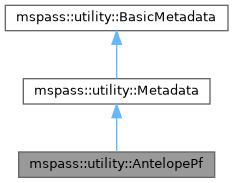
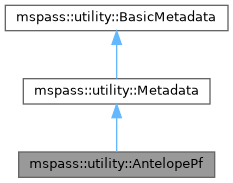
This object encapsulates the Antelope concept of a parameter file in a single wrapper. The main constructor is actually act much like the Antelope pfread procedure. Internally this object does not use an antelope Pf at all directly, but it is a child of Metadata. Simple attributes (i.e. key-value pairs) are posted directly to the Metadata associative array (map) container. Note that the parser attempts to guess the type of each value given in the obvious ways (periods imply real numbers, e or E imply real numbers, etc.) but the algorithm used may not be foolproof. The get methods are from the Metadata object. Be warned like the Metadata object the type of an entry for a key can change and will be the last one set. An Antelope Tbl in a pf file is converted to an stl list container of stl::string's that contain the input lines. This is a strong divergence from the tbl interface of Antelope, but one I judged a reasonable modernization. Similarly, Arr's are converted to what I am here calling a "branch". Branches are map indexed containers with the key pointing to nested versions of this sampe object type. This is in keeping with the way Arr's are used in antelope, but with an object flavor instead of the pointer style of pfget_arr. Thus, get_branch returns a AntelopePf object instead of a pointer that has to be memory managed. A final note about this beast is that the entire thing was created with a tacit assumption the object itself is not huge. i.e. this implementation may not scale well if applied to very large (millions) line pf files. This is a job for something like MongoDB. View this as a convenient format for building a Metadata object. Note, a code fragment to use this to create lower level metadata would go like this: AntelopePf pfdata("example"); //parameter file constructor Metadata md(dynamic_cast<Metadata&>(pfdata);
This version for MsPASS is derived from a similar thing called a PfStyleMetadata object in antelope contrib.
Constructor & Destructor Documentation
◆ AntelopePf() [1/4]
|
inline |
Default constructor - does nothing.
◆ AntelopePf() [2/4]
| mspass::utility::AntelopePf::AntelopePf | ( | std::string | pfbase | ) |
Construct from a base pf name.
This constructor acts like the antelope pfread function for parameter files constructed in plain C. A relative base name is first read from the MsPASS data directory when available: MSPASS_HOME/data when MSPASS_HOME is set, or the installed mspasspy package data after the Python extension registers it. A standalone caller without MSPASS_HOME instead starts with the directories defined by PFPATH; if PFPATH is not defined, that path defaults to ".". As with the antelope pfread procedure, the last file read takes precedence, so PFPATH or the current directory can override the MsPASS data file. Further if pfbase begins with a slash (i.e. "/") it is assumed to be the actual file name to read and the PFPATH feature is disabled.
- Parameters
-
pfbase is the base pf name. Relative names may include or omit the .pf suffix; it is added when absent.
- Exceptions
-
- throws a MsPASSError object with an informative message if constuctor fails for any reason.
References mspass::utility::Metadata::get().
◆ AntelopePf() [3/4]
| mspass::utility::AntelopePf::AntelopePf | ( | std::list< std::string > | lines | ) |
Construct from a set of text lines.
This is a cruder constructor that could be used for small pf file. Read the contents of a pf file into a vector of lines with each line being one line from the pf. The constructor then sequentially parses this series of lines as it would if reading from a file.
- Parameters
-
lines is the modified version of the text pf file.
References mspass::utility::Metadata::get(), and mspass::utility::Metadata::put().
◆ AntelopePf() [4/4]
| mspass::utility::AntelopePf::AntelopePf | ( | const AntelopePf & | parent | ) |
Standard copy constructor.
References mspass::utility::Metadata::get().
Member Function Documentation
◆ arr_keys()
Return a list of keys for branches (Arrs) in the pf file.
References mspass::utility::Metadata::get().
◆ ConvertToMetadata()
| Metadata mspass::utility::AntelopePf::ConvertToMetadata | ( | ) |
Return an object with only simple name:value pairs.
The Metadata parent of this object only handles name:value pairs. The values can, however, be any object boost::any can handle. The documentation says that means it is copy constructable. For now this method returns an object containin the boost::any values. Any Arr and Tbl entries are pushed directly to the output Metadata using boost::any and the two keys defined as const strings at the top of this file (pftbl_key and pfarr_key).
- Returns
- Metadata sans any Arr and Tbl entries.
References mspass::utility::Metadata::get(), and mspass::utility::Metadata::put().
◆ get_branch()
| AntelopePf mspass::utility::AntelopePf::get_branch | ( | const std::string | key | ) | const |
used for subtrees (nested Arrs in antelope)
This method is used for nested Arr constructs. This returns a copy of the branch defined by key attached to this object. The original from the parent is retained.
- Parameters
-
key is the key used to locate this branch.
- Returns
- a copy of the contents of the branch linked to key.
- Exceptions
-
AntelopePfError will be thrown if the key is not found.
References mspass::utility::Metadata::get().
◆ get_tbl()
get a Tbl component by key.
Antelope has the idea of a tbl, which is a list of lines that are parsed independently. This is the get method to extract one of these by its key.
- Parameters
-
key is the key for the Tbl desired.
- Exceptions
-
AntelopePfError will be thrown if the key is not present.
References mspass::utility::Metadata::get().
◆ operator=()
| AntelopePf & mspass::utility::AntelopePf::operator= | ( | const AntelopePf & | parent | ) |
Standard assignment operator,
References mspass::utility::Metadata::get(), and mspass::utility::Metadata::operator=().
◆ pfwrite()
| void mspass::utility::AntelopePf::pfwrite | ( | std::ostream & | ofs | ) |
save result in a pf format.
This is functionally equivalent to the Antelope pfwrite procedure, but is a member of this object. A feature of the current implementation is that all simply type parameters will usually be listed twice in the output file. The reason is that the constructor attempts to guess type, but to allow for mistakes all simple parameters are also treated as string variables so get methods are more robust.
- Parameters
-
ofs is a std::ostream (e.g. cout) where the result will be written in pf style. Usually should end in ".pf".
◆ tbl_keys()
Return a list of keys for Tbls in the pf.
References mspass::utility::Metadata::get().
The documentation for this class was generated from the following files:
- /home/runner/work/mspass/mspass/cxx/include/mspass/utility/AntelopePf.h
- /home/runner/work/mspass/mspass/cxx/src/lib/utility/AntelopePf.cc