MsPASS C++ API  2.4.4.dev122+gb075c5a7b
Defines the C++ API for MsPASS
Loading...
Searching...
No Matches
mspass::algorithms::CoreSeismogram Class Reference

Vector (three-component) seismogram data object. More...

#include <CoreSeismogram.h>
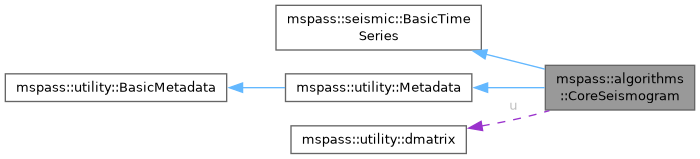
Inheritance diagram for mspass::algorithms::CoreSeismogram:
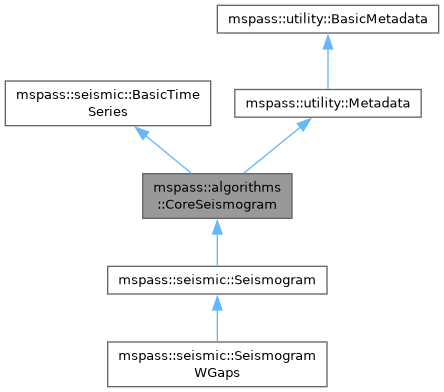
Collaboration diagram for mspass::algorithms::CoreSeismogram:

Public Member Functions

 CoreSeismogram ()
 CoreSeismogram (const size_t nsamples)
 CoreSeismogram (const std::vector< mspass::seismic::CoreTimeSeries > &ts, const unsigned int component_to_clone=0)
 CoreSeismogram (const mspass::utility::Metadata &md, const bool load_data=true)
 Construct from Metadata definition that includes data path.
 CoreSeismogram (const CoreSeismogram &)
void set_dt (const double sample_interval)
 Set the sample interval.
void set_npts (const size_t npts)
 Set the number of samples attribute for data.
void sync_npts ()
 Sync the number of samples attribute with actual data size.
void set_t0 (const double t0in)
 Set the data start time.
CoreSeismogram & operator= (const CoreSeismogram &)
CoreSeismogram & operator+= (const CoreSeismogram &d)
 Summation operator.
const CoreSeismogram operator+ (const CoreSeismogram &other) const
CoreSeismogram & operator*= (const double)
CoreSeismogram & operator-= (const CoreSeismogram &d)
 Subtraction operator.
const CoreSeismogram operator- (const CoreSeismogram &other) const
std::vector< double > operator[] (const int sample) const
std::vector< double > operator[] (const double time) const
 Overloaded version of operator[] for time.
virtual ~CoreSeismogram ()
void rotate_to_standard ()
void rotate (mspass::utility::SphericalCoordinate &sc)
void rotate (const double nu[3])
void rotate (const double phi)
 Rotate horizontals by a simple angle in degrees.
void transform (const double a[3][3])
void free_surface_transformation (const mspass::seismic::SlownessVector u, const double vp0, const double vs0)
mspass::utility::dmatrix get_transformation_matrix () const
bool set_transformation_matrix (const mspass::utility::dmatrix &A)
 Define the transformaton matrix.
bool set_transformation_matrix (const double a[3][3])
 Define the transformaton matrix with a C style 3x3 matrix.
bool set_transformation_matrix (pybind11::object a)
 Define the transformaton matrix with a python object.
bool cardinal () const
bool orthogonal () const
double endtime () const noexcept
Public Member Functions inherited from mspass::seismic::BasicTimeSeries
 BasicTimeSeries ()
 BasicTimeSeries (const BasicTimeSeries &)
virtual ~BasicTimeSeries ()
 Virtual destructor.
double time (const int i) const
int sample_number (double t) const
double endtime () const noexcept
bool shifted () const
double get_t0shift () const
double time_reference () const
void force_t0_shift (const double t)
 Force a t0 shift value on data.
virtual void ator (const double tshift)
virtual void rtoa ()
virtual void shift (const double dt)
bool live () const
bool dead () const
void kill ()
void set_live ()
double dt () const
bool time_is_UTC () const
bool time_is_relative () const
TimeReferenceType timetype () const
double samprate () const
size_t npts () const
double t0 () const
std::vector< double > time_axis () const
void set_tref (const TimeReferenceType newtref)
 Force the time standard.
BasicTimeSeries & operator= (const BasicTimeSeries &parent)

Public Attributes

mspass::utility::dmatrix u

Protected Attributes

bool components_are_orthogonal
bool components_are_cardinal
double tmatrix [3][3]
Protected Attributes inherited from mspass::seismic::BasicTimeSeries
bool mlive
double mdt
double mt0
size_t nsamp
TimeReferenceType tref
bool t0shift_is_valid
double t0shift

Detailed Description

Vector (three-component) seismogram data object.

A three-component seismogram is a common concept in seismology. The concept used here is that a three-component seismogram is a time series with a 3-vector as the data at each time step. As a result the data are stored internally as a matrix with row defining the component number (C indexing 0,1,2) and the column defining the time variable. The object inherits common concepts of a time series through the BasicTimeSeries object. Auxiliary parameters are defined for the object through inheritance of a Metadata object.

Author
Gary L. Pavlis

Constructor & Destructor Documentation

◆ CoreSeismogram() [1/5]

Default constructor.

Sets ns to zero and builds an empty data matrix. The live variable in BasicTimeSeries is also set false.

28 /* mlive and tref are set in BasicTimeSeries so we don't use putters for
29 them here. These three initialize Metadata properly for these attributes*/
30 this->set_dt(1.0);
31 this->set_t0(0.0);
32 this->set_npts(0);
35 for (int i = 0; i < 3; ++i)
36 for (int j = 0; j < 3; ++j)
37 if (i == j)
38 tmatrix[i][i] = 1.0;
39 else
40 tmatrix[i][j] = 0.0;
41}
double tmatrix[3][3]
Definition CoreSeismogram.h:532
bool components_are_orthogonal
Definition CoreSeismogram.h:515
bool components_are_cardinal
Definition CoreSeismogram.h:524
BasicTimeSeries()
Definition BasicTimeSeries.cc:45
void set_dt(const double sample_interval)
Set the sample interval.
Definition CoreSeismogram.cc:1016
void set_t0(const double t0in)
Set the data start time.
Definition CoreSeismogram.cc:1032
void set_npts(const size_t npts)
Set the number of samples attribute for data.
Definition CoreSeismogram.cc:1049
Metadata()
Definition Metadata.h:105

◆ CoreSeismogram() [2/5]

Simplest parameterized constructor.

Initializes data and sets aside memory for matrix of size 3xnsamples. The data matrix is not initialized and the object is marked as not live.

Parameters
nsamplesnumber of samples expected for holding data.
44 /* IMPORTANT: this constructor assumes BasicTimeSeries initializes the
45 equivalent of:
46 set_dt(1.0)
47 set_t0(0.0)
48 set_tref(TimeReferenceType::Relative)
49 this->kill() - i.e. marked dead
50 */
51 this->set_npts(
52 nsamples); // Assume this is an allocator of the 3xnsamples matrix
55 for (int i = 0; i < 3; ++i)
56 for (int j = 0; j < 3; ++j)
57 if (i == j)
58 tmatrix[i][i] = 1.0;
59 else
60 tmatrix[i][j] = 0.0;
61}

◆ CoreSeismogram() [3/5]

mspass::seismic::CoreSeismogram::CoreSeismogram ( const std::vector< mspass::seismic::CoreTimeSeries > & ts,
const unsigned int component_to_clone = 0 )

Construct a three component seismogram from three TimeSeries objects.

A three component seismogram is commonly assembled from individual single channel components. This constructor does the process taking reasonable care to deal with (potentially) irregular start and end times of the individual components. If the start and end times are all the same it uses a simple copy operation. Otherwise it runs a more complicated (read much slower) algorithm that handles the ragged start and stop times by adding a marked gap.

If start or end times are not constant the algorithm shortens the output to the latest start time and earliest end time respectively.

Note this constructor requires variables hang and vang, which are orientation angles defined in the CSS3.0 schema (NOT spherical coordinates by the way), by set for each component. This is used to construct the transformation matrix for the object that allows, for example, removing raw data orientation errors using rotate_to_standard. The constructor will throw an exception if any component does not have these attributes set in their Metadata area.

Exceptions
SeisppErrorexception can be throw for a variety of serious problems.
Parameters
tsvector of 3 TimeSeries objects to be used to assemble this Seismogram. Input vector order could be arbitrary because a transformation matrix is computed, but for efficiency standard order (E,N,Z) is advised.
component_to_clonethe auxiliary parameters (Metadata and BasicTimeSeries common parameters) from one of the components is cloned to assure common required parameters are copied to this object. This argument controls which of the three components passed through ts is used. Default is 0.
212 dynamic_cast<const BasicTimeSeries &>(ts[component_to_clone])),
213 Metadata(dynamic_cast<const Metadata &>(ts[component_to_clone])), u() {
214 const string base_error("CoreSeismogram constructor from 3 Time Series: ");
215 int i, j;
216 /* This is needed in case nsamp does not match s.size(0) */
217 int nstest = ts[component_to_clone].s.size();
218 if (nsamp != nstest)
219 this->nsamp = nstest;
220 /* this method allocates u and sets the proper metadata for npts*/
221 this->CoreSeismogram::set_npts(this->nsamp);
222 /* beware irregular sample rates, but don' be too machevelian.
223 Abort only if the mismatch is large defined as accumulated time
224 over data range of this constructor is less than half a sample */
225 if ((ts[0].dt() != ts[1].dt()) || (ts[1].dt() != ts[2].dt())) {
226 double ddtmag1 = fabs(ts[0].dt() - ts[1].dt());
227 double ddtmag2 = fabs(ts[1].dt() - ts[2].dt());
228 double ddtmag;
229 if (ddtmag1 > ddtmag1)
230 ddtmag = ddtmag1;
231 else
232 ddtmag = ddtmag2;
233 ddtmag1 = fabs(ts[0].dt() - ts[2].dt());
234 if (ddtmag1 > ddtmag)
235 ddtmag = ddtmag1;
236 double ddtcum = ddtmag * ((double)ts[0].s.size());
237 if (ddtcum > (ts[0].dt()) / 2.0) {
238 stringstream ss;
239 ss << base_error << "Sample intervals of components are not consistent"
240 << endl;
241 for (int ie = 0; ie < 3; ++ie)
242 ss << "Component " << ie << " dt=" << ts[ie].dt() << " ";
243 ss << endl;
244 throw MsPASSError(ss.str(), ErrorSeverity::Invalid);
245 }
246 }
247 // temporaries to hold component values
248 double t0_component[3];
249 double hang[3];
250 double vang[3];
251 // Load up these temporary arrays inside this try block and arrange to
252 // throw an exception if required metadata are missing
253 try {
254 /* WARNING hang and vang attributes in Metadata
255 are always assumed to have been read from a database where they
256 were stored in degrees. We convert these to radians below to
257 compute the transformation matrix.
258
259 Feb 2021: converted to use keywords.h definitions assuming these
260 came from the channel collection in MongoDB - Can be changed in
261 kewords.h for application outside mspass */
262 hang[0] = ts[0].get_double(SEISMICMD_hang);
263 hang[1] = ts[1].get_double(SEISMICMD_hang);
264 hang[2] = ts[2].get_double(SEISMICMD_hang);
265 vang[0] = ts[0].get_double(SEISMICMD_vang);
266 vang[1] = ts[1].get_double(SEISMICMD_vang);
267 vang[2] = ts[2].get_double(SEISMICMD_vang);
268 } catch (MetadataGetError &mde) {
269 stringstream ss;
270 ss << base_error
271 << "missing hang or vang variable in component TimeSeries objects "
272 "received"
273 << endl;
274 ss << "Message posted by Metadata::get_double: " << mde.what() << endl;
275 throw MsPASSError(ss.str(), ErrorSeverity::Invalid);
276 }
277 /* We couldn't get here if hang and vang were not set on comp 0 so
278 we don't test for that condition. We do need to clear hang and vang
279 from result here, however, as both attributes are meaningless
280 for a 3C seismogram */
281 this->erase(SEISMICMD_hang);
282 this->erase(SEISMICMD_vang);
283 // These are loaded just for convenience
284 t0_component[0] = ts[0].t0();
285 t0_component[1] = ts[1].t0();
286 t0_component[2] = ts[2].t0();
287
288 // Treat the normal case specially and avoid a bunch of work unless
289 // it is required
290 if ((ts[0].s.size() == ts[1].s.size()) &&
291 (ts[1].s.size() == ts[2].s.size()) &&
292 (fabs((t0_component[0] - t0_component[1]) / dt()) < 1.0) &&
293 (fabs((t0_component[1] - t0_component[2]) / dt()) < 1.0)) {
294 /* Older code had this. No longer needed with logic above that
295 calls set_npts. that method creates and initialized the u dmatrix*/
296 // this->u=dmatrix(3,nsamp);
297 // Load data by a simple copy operation
298 /* This is a simple loop version
299 for(j=0;j<nsamp;++nsamp)
300 {
301 this->u(0,j)=ts[0].s[j];
302 this->u(1,j)=ts[1].s[j];
303 this->u(2,j)=ts[2].s[j];
304 }
305 */
306 // This is a vector version that I'll use because it will
307 // be faster albeit infinitely more obscure and
308 // intrinsically more dangerous
309 dcopy(nsamp, &(ts[0].s[0]), 1, u.get_address(0, 0), 3);
310 dcopy(nsamp, &(ts[1].s[0]), 1, u.get_address(1, 0), 3);
311 dcopy(nsamp, &(ts[2].s[0]), 1, u.get_address(2, 0), 3);
312 } else {
313 /*Land here if the start time or number of samples
314 is irregular. We cut the output to latest start time to earliest end time*/
315 /* WARNING - debugging may be needed for this block. SEISPP versio of this
316 used gaps. Here we cut the output to match an irregularities. */
317 double tsmax, temin;
318 tsmax = max(t0_component[0], t0_component[1]);
319 tsmax = max(tsmax, t0_component[2]);
320 temin = min(ts[0].endtime(), ts[1].endtime());
321 temin = min(temin, ts[2].endtime());
322 nstest = (int)round((temin - tsmax) / mdt);
323 if (nstest <= 0)
324 throw MsPASSError(
325 base_error + "Irregular time windows of components have no overlap",
326 ErrorSeverity::Invalid);
327 else
328 this->CoreSeismogram::set_npts(nstest);
329 // Now load the data. Use the time and sample number methods
330 // to simplify process
331 double t;
332 t = tsmax;
333 this->set_t0(t);
334 double delta = this->dt();
335 for (int ic = 0; ic < 3; ++ic) {
336 t = this->t0();
337 for (j = 0; j < ts[ic].s.size(); ++j) {
338 i = ts[ic].sample_number(t);
339 // silently do nothing if outside bounds. This
340 // perhaps should be an error as it shouldn't really
341 // happen with the above algorithm, but safety is good
342 if ((i >= 0) && (i < nsamp))
343 this->u(ic, j) = ts[ic].s[i];
344 t += delta;
345 }
346 }
347 }
348 /* Finally we need to set the transformation matrix.
349 This is a direct application of conversion of routines
350 in spherical coordinate procedures. They are procedural
351 routines, not objects so the code is procedural.
352 */
353 SphericalCoordinate scor;
354 double *nu;
355 // convert all the hang values to spherical coordinate phi
356 // (angle from postive east) from input assumed in degrees
357 // azimuth from north. At the same time convert vang to radians.
358 for (i = 0; i < 3; ++i) {
359 hang[i] = mspass::utility::rad(90.0 - hang[i]);
360 vang[i] = mspass::utility::rad(vang[i]);
361 }
362 for (i = 0; i < 3; ++i) {
363 scor.phi = hang[i];
364 scor.theta = vang[i];
365 nu = SphericalToUnitVector(scor);
366 for (j = 0; j < 3; ++j)
367 tmatrix[i][j] = nu[j];
368 delete[] nu;
369 }
370 components_are_cardinal = this->tmatrix_is_cardinal();
373 else
375 /* Last but not least set the datum live before returning */
376 this->set_live();
377}
mspass::utility::dmatrix u
Definition CoreSeismogram.h:52
size_t nsamp
Definition BasicTimeSeries.h:257
void set_live()
Definition BasicTimeSeries.h:151
double t0() const
Definition BasicTimeSeries.h:176
double mdt
Definition BasicTimeSeries.h:249
double dt() const
Definition BasicTimeSeries.h:153
mspass::utility::dmatrix u
Definition CoreSeismogram.h:52
double endtime() const noexcept
Definition CoreSeismogram.h:500
void erase(const std::string key)
Definition Metadata.cc:495
const std::string SEISMICMD_vang("channel_vang")
const std::string SEISMICMD_hang("channel_hang")

◆ CoreSeismogram() [4/5]

mspass::seismic::CoreSeismogram::CoreSeismogram ( const mspass::utility::Metadata & md,
const bool load_data = true )

Construct from Metadata definition that includes data path.

A Metadata object is sufficiently general that it can contain enough information to contruct an object from attributes contained in it. This constuctor uses that approach, with the actual loading of data being an option (on by default). In mspass this is constructor is used to load data with Metadata constructed from MongoDB and then using the path created from two parameters (dir and dfile used as in css3.0 wfdisc) to read data. The API is general but the implementation in mspass is very rigid. It blindly assumes the data being read are binary doubles in the right byte order and ordered in the native order for dmatrix (Fortran order). i.e. the constuctor does a raw fread of ns*3 doubles into the internal array used in the dmatrix implementation.

A second element of the Metadata that is special for MsPASS is the handling of the transformation matrix by this constructor. In MsPASS the transformation matrix is stored as a python object in MongoDB. This constructor aims to fetch that entity with the key 'tmatrix'. To be more robust and simpler to use with data not loaded from mongodb we default tmatrix to assume the data are in standard coordinates. That is, if the key tmatrix is not defined in Metadata passed as arg0, the constructor assumes it should set the transformation matrix to an identity. Use set_transformation_matrix if that assumption is wrong for your data.

Parameters
mdis the Metadata used for the construction.
load_dataif true (default) a file name is constructed from dir+"/"+dfile, the file is openned, fseek is called to foff, data are read with fread, and the file is closed. If false a dmatrix for u is still created of size 3xns, but the matrix is only initialized to all zeros.
Exceptions
Willthrow a MsPASSError if required metadata are missing.
94 : Metadata(md) {
95 string dfile, dir;
96 long foff;
97 FILE *fp;
98 double *inbuffer;
99
101 mlive = false;
102 try {
103 /* Names used are from mspass defintions as of Jan 2020.
104 We don't need to call the set methods for these attributes as they
105 would add the overhead of setting delta, startime, and npts to the
106 same value passed. */
107 this->mdt = this->get_double(SEISMICMD_dt);
108 this->mt0 = this->get_double(SEISMICMD_t0);
110 if (this->get_string(SEISMICMD_time_standard) == "UTC")
112 else {
114 /* For now we can't post an error because this is CoreSeismogram
115 so elog is not defined. For now let this error be silent as it
116 is harmless */
117 /*
118 this->elog.log_error("CoreSeismogram Metadata constructor",
119 SEISMICMD_time_standard+" attribute is not defined - set to Relative",
120 ErrorSeverity::Complaint);
121 */
122 }
123 }
124 if (this->time_is_relative()) {
125 /* It is not an error if a t0 shift is not defined and we are
126 in relative time. That is the norm for active source data. */
127 if (this->is_defined(SEISMICMD_t0_shift)) {
128 double t0shift = this->get_double(SEISMICMD_t0_shift);
129 this->force_t0_shift(t0shift);
130 }
131 }
132 /* This section is done specially to handle interaction with MongoDB.
133 We store tmatrix there as a python object so we use a get_any to fetch
134 it. Oct 22, 2021 added a bug fix to handle tmatrix not defined.
135 We will take a null (undefined) tmatrix stored in the database to
136 imply the data are cardinal and orthogonal (i.e. stardard geographic
137 coordinates in e,n,z order.)*/
138 if (this->is_defined("tmatrix")) {
140 boost::any_cast<py::object>(this->get_any("tmatrix")));
141 components_are_cardinal = this->tmatrix_is_cardinal();
144 else
145 components_are_orthogonal = false; // May be wrong but cost is tiny
146 } else {
147 /* this might not be needed but best be explicit*/
148 for (auto i = 0; i < 3; ++i)
149 for (auto j = 0; j < 3; ++j)
150 this->tmatrix[i][j] = 0.0;
151 for (auto i = 0; i < 3; ++i)
152 this->tmatrix[i][i] = 1.0;
155 }
156 /* We have to handle nsamp specially in the case when load_data
157 is false. To be consistent with TimeSeries we use a feature that
158 if the Metadata container does not define npts we default it.
159 In this case that means the default constructor for u and set
160 nsamp to 0 (via set_npts). */
161 if (md.is_defined(SEISMICMD_npts)) {
162 long int ns = md.get_long(SEISMICMD_npts);
163 this->set_npts(ns); /* note this is assumed to initialize u*/
164 } else {
165 this->set_npts(0);
166 }
167 /* Note previous code had an else clause to to with the
168 following conditional. It used to zero the u matrix.
169 The call to set_npts above will always do that so that would
170 have been redundant and was removed June 2022*/
171 if (load_data) {
172 dir = this->get_string(SEISMICMD_dir);
173 dfile = this->get_string(SEISMICMD_dfile);
174 foff = this->get_long(SEISMICMD_foff);
175 string fname = dir + "/" + dfile;
176 if ((fp = fopen(fname.c_str(), "r")) == NULL)
177 throw(MsPASSError(string("Open failure for file ") + fname,
178 ErrorSeverity::Invalid));
179 if (foff > 0)
180 fseek(fp, foff, SEEK_SET);
181 /* The older seispp code allowed byte swapping here. For
182 efficiency we don't support that here and assume can do a
183 raw fread from the file and get valid data. If support for
184 other types is needed this will need to be extended. Here
185 we just point fread at the internal u array. */
186 inbuffer = this->u.get_address(0, 0);
187 unsigned int nt = 3 * this->nsamp;
188 if (fread((void *)(inbuffer), sizeof(double), nt, fp) != nt) {
189 fclose(fp);
190 throw(MsPASSError(
191 string("CoreSeismogram constructor: fread error on file ") + fname,
192 ErrorSeverity::Invalid));
193 }
194 fclose(fp);
195 mlive = true;
196 }
197 } catch (MsPASSError &mpe) {
198 throw(mpe);
199 } catch (boost::bad_any_cast &be) {
200 throw(MsPASSError(
201 string("CoreSeismogram constructor: tmatrix type is not recognized"),
202 ErrorSeverity::Invalid));
203 } catch (...) {
204 throw;
205 };
206}
bool mlive
Definition BasicTimeSeries.h:245
bool time_is_relative() const
Definition BasicTimeSeries.h:162
void force_t0_shift(const double t)
Force a t0 shift value on data.
Definition BasicTimeSeries.h:109
void set_tref(const TimeReferenceType newtref)
Force the time standard.
Definition BasicTimeSeries.h:235
double t0shift
Definition BasicTimeSeries.h:274
double mt0
Definition BasicTimeSeries.h:253
bool set_transformation_matrix(const mspass::utility::dmatrix &A)
Define the transformaton matrix.
Definition CoreSeismogram.cc:785
bool is_defined(const std::string key) const noexcept
Definition Metadata.cc:342
long get_long(const std::string key) const
Definition Metadata.cc:379
std::map< std::string, boost::any > md
Definition Metadata.h:473
boost::any get_any(const std::string key) const
Definition Metadata.h:256
std::string get_string(const std::string key) const override
Definition Metadata.h:189
double get_double(const std::string key) const override
Definition Metadata.cc:352
const std::string SEISMICMD_t0_shift("starttime_shift")
@ Relative
Definition BasicTimeSeries.h:17
@ UTC
Definition BasicTimeSeries.h:15
const std::string SEISMICMD_dfile("dfile")
const std::string SEISMICMD_foff("foff")
const std::string SEISMICMD_t0("starttime")
const std::string SEISMICMD_dt("delta")
const std::string SEISMICMD_time_standard("time_standard")
const std::string SEISMICMD_dir("dir")
const std::string SEISMICMD_npts("npts")

◆ CoreSeismogram() [5/5]

mspass::seismic::CoreSeismogram::CoreSeismogram ( const CoreSeismogram & t3c)

Standard copy constructor.

64 : BasicTimeSeries(dynamic_cast<const BasicTimeSeries &>(t3c)),
65 Metadata(dynamic_cast<const Metadata &>(t3c)), u(t3c.u) {
66 int i, j;
67 components_are_orthogonal = t3c.components_are_orthogonal;
68 components_are_cardinal = t3c.components_are_cardinal;
69 for (i = 0; i < 3; ++i)
70 for (j = 0; j < 3; ++j)
71 tmatrix[i][j] = t3c.tmatrix[i][j];
72}

◆ ~CoreSeismogram()

Standard destructor.

306{};

Member Function Documentation

◆ cardinal()

Returns true of components are cardinal.

493{ return components_are_cardinal; };

◆ endtime()

double mspass::seismic::CoreSeismogram::endtime ( ) const
inlinenoexcept

Returns the end time (time associated with last data sample) of this data object.

500 {
501 return (mt0 + mdt * static_cast<double>(u.columns() - 1));
502 };

◆ free_surface_transformation()

Computes and applies the Kennett [1991] free surface transformation matrix.

Kennett [1991] gives the form for a free surface transformation operator that reduces to a nonorthogonal transformation matrix when the wavefield is not evanescent. On output x1 will be transverse, x2 will be SV (radial), and x3 will be longitudinal.

Parameters
uslowness vector off the incident wavefield
vp0Surface P wave velocity
vs0Surface S wave velocity.
711 {
712 if ((u.size()[1] <= 0) || dead())
713 return; // do nothing in these situations
714 double a02, b02, pslow, p2;
715 double qa, qb, vpz, vpr, vsr, vsz;
716 // Validate before rotating so invalid parameters cannot mutate the datum.
717 if (!std::isfinite(a0) || !std::isfinite(b0) || a0 <= 0.0 ||
718 b0 <= 0.0 || !std::isfinite(uvec.ux) || !std::isfinite(uvec.uy))
719 throw MsPASSError(
720 "CoreSeismogram::free_surface_transformation: surface velocities "
721 "must be finite and positive and slowness components finite",
722 ErrorSeverity::Invalid);
723 pslow = uvec.mag();
724 // The vertical wavenumbers vanish at critical incidence. Equality must
725 // also be rejected to avoid division by zero in vpz or vsr.
726 if (!std::isfinite(pslow) || pslow * a0 >= 1.0 ||
727 pslow * b0 >= 1.0) {
728 stringstream ss;
729 ss << "CoreSeismogram::free_surface_transformation: critical or "
730 "evanescent incidence (horizontal slowness="
731 << pslow << ", vp=" << a0 << ", vs=" << b0 << ")";
732 throw MsPASSError(ss.str(), ErrorSeverity::Invalid);
733 }
734
735 // First the horizonal rotation
736 SphericalCoordinate scor;
737 // rotation angle is - azimuth to put x2 (north in standard coord)
738 // in radial direction
739 // Normal incidence has no preferred horizontal direction. Honor the
740 // optional zero-slowness propagation azimuth stored by SlownessVector;
741 // the P, SV and SH free-surface amplitude corrections still apply.
742 scor.phi = (pslow == 0.0) ? (M_PI_2 - uvec.azimuth())
743 : atan2(uvec.uy, uvec.ux);
744 if (!std::isfinite(scor.phi))
745 throw MsPASSError(
746 "CoreSeismogram::free_surface_transformation: invalid azimuth",
747 ErrorSeverity::Invalid);
748 scor.theta = 0.0;
749 scor.radius = 1.0;
750 // after this transformation x1=transverse horizontal
751 // x2=radial horizonal, and x3 is still vertical
752 this->rotate(scor);
753
754 a02 = a0 * a0;
755 b02 = b0 * b0;
756 p2 = pslow * pslow;
757 qa = sqrt((1.0 / a02) - p2);
758 qb = sqrt((1.0 / b02) - p2);
759 vpz = -(1.0 - 2.0 * b02 * p2) / (2.0 * a0 * qa);
760 vpr = pslow * b02 / a0;
761 vsr = (1.0 - 2.0 * b02 * p2) / (2.0 * b0 * qb);
762 vsz = pslow * b0;
763 /* Now construct the transformation matrix
764 This is different from Bostock's original code
765 in sign and order. Also note this transformation
766 is not scaled to have a unit matrix norm so amplitudes
767 after the transformation are distorted. rotate_to_standard,
768 however, should still restore original data within roundoff
769 error if called on the result. */
770 double fstran[3][3];
771 fstran[0][0] = 0.5;
772 fstran[0][1] = 0.0;
773 fstran[0][2] = 0.0;
774 fstran[1][0] = 0.0;
775 fstran[1][1] = vsr;
776 fstran[1][2] = -vsz;
777 fstran[2][0] = 0.0;
778 fstran[2][1] = vpr;
779 fstran[2][2] = -vpz;
780 this->transform(fstran);
781
784}
bool dead() const
Definition BasicTimeSeries.h:145
void rotate(mspass::utility::SphericalCoordinate &sc)
Definition CoreSeismogram.cc:526
void transform(const double a[3][3])
Definition CoreSeismogram.cc:657

◆ get_transformation_matrix()

Return current transformation matrix.

The transformation matrix is maintained internally in this object. Transformations like rotations and the transform method can change make this matrix not an identity matrix. It should always be an identity matrix when the coordinates are cardinal (i.e. ENZ).

Returns
3x3 transformation matrix.
443 {
444 mspass::utility::dmatrix result(3, 3);
445 for (int i = 0; i < 3; ++i)
446 for (int j = 0; j < 3; ++j)
447 result(i, j) = tmatrix[i][j];
448 return result;
449 };

◆ operator*=()

CoreSeismogram & mspass::seismic::CoreSeismogram::operator*= ( const double scale)

Multiply data by a scalar.

913 {
914 /* do nothing to empty data or data marked dead*/
915 if ((this->npts() == 0) || (this->dead()))
916 return (*this);
917 /* We can use this dscal blas function because dmatrix puts all the data
918 in a continguous block. Beware if there is am implementation change for
919 the matrix data*/
920 double *ptr = this->u.get_address(0, 0);
921 dscal(3 * this->npts(), scale, ptr, 1);
922 return (*this);
923}
size_t npts() const
Definition BasicTimeSeries.h:173

◆ operator+()

const CoreSeismogram mspass::seismic::CoreSeismogram::operator+ ( const CoreSeismogram & other) const

Addition operator.

This operator is implemented in a standard way utilizing operator+=. For data with irregular start and end times that has an important consequence; the operator is not communative. i.e given x an y z=x+y will not yield the same result as z=y+x.

1005 {
1006 CoreSeismogram result(*this);
1007 result += other;
1008 return result;
1009}
CoreSeismogram()
Definition CoreSeismogram.cc:27

◆ operator+=()

CoreSeismogram & mspass::seismic::CoreSeismogram::operator+= ( const CoreSeismogram & d)

Summation operator.

Summing data from signals of irregular length requires handling potential mismatches in size and overlap. This behaves the way a += operator should logically behave in that situation. That is, because the lhs is where the sum is being accumulated, the size is always controlled by the left hand side of the operator. Any portions of the right hand side that are outside the t0 to endtime() of the left hand side are silently discarded. If the start time of the right hand side is greater than t0 or the endtime is less than endtime of the lhs there will be discontinuties in the sum there the ends of the rhs are inside the range of the lhs.

Parameters
dis other signal to add to this. The overlap boundaries are rounded to nearby sample indices, then samples are paired consecutively. This approximate operation does not resample either signal; differences in sample interval or start-time grid are accepted.
Exceptions
MsPASSErrorif lhs and rhs have incompatible time standards.
924 {
925 int i, iend, jend;
926 size_t j, i0, j0;
927 // Silently do nothing if d or lhs is marked dead
928 if (d.dead() || (this->dead()))
929 return (*this);
930 // Silently do nothing if d does not overlap with data to contain sum
931 if ((d.endtime() < mt0) || (d.mt0 > (this->endtime())))
932 return (*this);
933 if (d.tref != (this->tref))
934 throw MsPASSError("CoreSeismogram += operator cannot handle data with "
935 "inconsistent time base\n",
936 ErrorSeverity::Invalid);
937 /* this defines the range of left and right hand sides to be summed */
938 i = d.sample_number(this->mt0);
939 if (i < 0) {
940 j0 = this->sample_number(d.t0());
941 i0 = 0;
942 } else {
943 j0 = 0;
944 i0 = i;
945 }
946 iend = d.sample_number(this->endtime());
947 jend = this->sample_number(d.endtime());
948 if (iend >= (d.npts())) {
949 iend = d.npts() - 1;
950 }
951 if (jend >= this->npts()) {
952 jend = this->npts() - 1;
953 }
954 for (i = i0, j = j0; i <= iend && j <= jend; ++i, ++j) {
955 this->u(0, j) += d.u(0, i);
956 this->u(1, j) += d.u(1, i);
957 this->u(2, j) += d.u(2, i);
958 }
959 return (*this);
960}
int sample_number(double t) const
Definition BasicTimeSeries.h:72

◆ operator-()

const CoreSeismogram mspass::seismic::CoreSeismogram::operator- ( const CoreSeismogram & other) const

Subtraction operator.

This operator is implemented in a standard way utilizing operator-=. For data with irregular start and end times that has an important consequence; the operator is not communative. i.e given x an y z=x-y will not yield the same result as z=-(y-x).

1011 {
1012 CoreSeismogram result(*this);
1013 result -= other;
1014 return result;
1015}

◆ operator-=()

CoreSeismogram & mspass::seismic::CoreSeismogram::operator-= ( const CoreSeismogram & d)

Subtraction operator.

Differencing data from signals of irregular length requires handling potential mismatches in size and overlap. This behaves the way a -= operator should logically behave in that situation. That is, because the lhs is where the sum is being accumulated, the size is always controlled by the left hand side of the operator. Any portions of the right hand side that are outside the t0 to endtime() of the left hand side are silently discarded. If the start time of the right hand side is greater than t0 or the endtime is less than endtime of the lhs there will be discontinuties in the sum there the ends of the rhs are inside the range of the lhs.

Parameters
dis other signal to subract from this. The overlap boundaries are rounded to nearby sample indices, then samples are paired consecutively. This approximate operation does not resample either signal; differences in sample interval or start-time grid are accepted.
Exceptions
MsPASSErrorif lhs and rhs have incompatible time standards.
965 {
966 int i, iend, jend;
967 size_t j, i0, j0;
968 // Sun's compiler complains about const objects without this.
969 CoreSeismogram &d = const_cast<CoreSeismogram &>(data);
970 // Silently do nothing if d is marked dead
971 if (!d.mlive)
972 return (*this);
973 // Silently do nothing if d does not overlap with data to contain sum
974 if ((d.endtime() < mt0) || (d.mt0 > (this->endtime())))
975 return (*this);
976 if (d.tref != (this->tref))
977 throw MsPASSError("CoreSeismogram += operator cannot handle data with "
978 "inconsistent time base\n",
979 ErrorSeverity::Invalid);
980 /* this defines the range of left and right hand sides to be summed */
981 i = d.sample_number(this->mt0);
982 if (i < 0) {
983 j0 = this->sample_number(d.t0());
984 i0 = 0;
985 } else {
986 j0 = 0;
987 i0 = i;
988 }
989 iend = d.sample_number(this->endtime());
990 jend = this->sample_number(d.endtime());
991 if (iend >= (d.npts())) {
992 iend = d.npts() - 1;
993 }
994 if (jend >= this->npts()) {
995 jend = this->npts() - 1;
996 }
997 for (i = i0, j = j0; i <= iend && j <= jend; ++i, ++j) {
998 this->u(0, j) -= d.u(0, i);
999 this->u(1, j) -= d.u(1, i);
1000 this->u(2, j) -= d.u(2, i);
1001 }
1002 return (*this);
1003}

◆ operator=()

CoreSeismogram & mspass::seismic::CoreSeismogram::operator= ( const CoreSeismogram & seisin)

Standard assignment operator.

898 {
899 if (this != &seisin) {
900 this->BasicTimeSeries::operator=(seisin);
901 this->Metadata::operator=(seisin);
902 components_are_orthogonal = seisin.components_are_orthogonal;
903 components_are_cardinal = seisin.components_are_cardinal;
904 for (int i = 0; i < 3; ++i) {
905 for (int j = 0; j < 3; ++j) {
906 tmatrix[i][j] = seisin.tmatrix[i][j];
907 }
908 }
909 u = seisin.u;
910 }
911 return (*this);
912}
BasicTimeSeries & operator=(const BasicTimeSeries &parent)
Definition BasicTimeSeries.cc:63
Metadata & operator=(const Metadata &mdold)
Definition Metadata.cc:460

◆ operator[]() [1/2]

vector< double > mspass::seismic::CoreSeismogram::operator[] ( const double time) const

Overloaded version of operator[] for time.

Sometimes it is useful to ask for data at a specified time without worrying about the time conversion. This simplifies that process. It is still subject to an exception if the the time requested is outside the data range.

Parameters
timeis the time of the requested sample
Returns
3 vector of data samples at requested time
Exceptions
MsPASSErrorwill be thrown if the time is outside the data range.
1107 {
1108 try {
1109 vector<double> result;
1110 int i = this->sample_number(t);
1111 /* could test for a negative i and i too large but we assume
1112 the dmatrix container will throw an exception if it resolves that way*/
1113 for (int k = 0; k < 3; ++k)
1114 result.push_back(this->u(k, i));
1115 return result;
1116 } catch (...) {
1117 throw;
1118 };
1119}

◆ operator[]() [2/2]

vector< double > mspass::seismic::CoreSeismogram::operator[] ( const int sample) const

Extract a sample from data vector.

A sample in this context means a three-vector at a requested sample index. Range checking is implicit because of the internal use of the dmatrix to store the samples of data. This operator is an alternative to extracting samples through indexing of the internal dmatrix u that holds the data.

Parameters
sampleis the sample number requested (must be in range or an exception will be thrown)
Exceptions
MsPASSErrorif the requested sample is outside the range of the data. Note this includes an implicit "outside" defined when the contents are marked dead. Note the code does this by catching an error thrown by dmatrix in this situation, printing the error message from the dmatrix object, and then throwing a new SeisppError with a shorter message.
Returns
std::vector containing a 3 vector of the samples at requested sample number
1096 {
1097 try {
1098 vector<double> result;
1099 result.reserve(3);
1100 for (int k = 0; k < 3; ++k)
1101 result.push_back(this->u(k, i));
1102 return result;
1103 } catch (...) {
1104 throw;
1105 };
1106}

◆ orthogonal()

Return true if the components are orthogonal.

495{ return components_are_orthogonal; };

◆ rotate() [1/3]

void mspass::seismic::CoreSeismogram::rotate ( const double nu[3])

Rotate data using a P wave type coordinate definition.

In seismology the longitudinal motion direction of a P wave defines a direction in space. This method rotates the data into a coordinate system defined by a direction passed through the argument. The data are rotated such that x1 becomes the transverse component, x2 becomes radial, and x3 becomes longitudinal. In the special case for a vector pointing in the x3 direction the data are not altered.

This method effectively turns nu into a SphericalCoordinate object and calles the related rotate method that has a SphericalCoordinate object as an argument. The potential confusion of orientation is not as extreme here. After the transformation x3prime will point in the direction of nu, x2 will be in the x3-x3prime plane (rotation by theta) and orthogonal to x3prime, and x1 will be horizontal and perpendicular to x2prime and x3prime.

A VERY IMPORTANT thing to recognize about this tranformation is it will always yield a result relative to cardinal coordinates. i.e. if the data had been previously rotated or were not originally in ENZ form they will be first transformed to ENZ before actually performing this transformation. Use the transform or horizontal rotation method to

Parameters
nudefines direction of x3 direction (longitudinal) as a unit vector with three components.
597 {
598 if ((u.size()[1] <= 0) || this->dead())
599 return; // do nothing in these situations
600 SphericalCoordinate xsc = UnitVectorToSpherical(nu);
601 this->rotate(xsc);
602}

◆ rotate() [2/3]

void mspass::seismic::CoreSeismogram::rotate ( const double phi)

Rotate horizontals by a simple angle in degrees.

A common transformation in 3C processing is a rotation of the horizontal components by an angle. This leaves the vertical (assumed here x3) unaltered. This routine rotates the horizontals by angle phi using with positive phi counterclockwise as in polar coordinates and the azimuth angle of spherical coordinates.

Note this transformation is cummulative. i.e. this transformation is cumulative. The internal transformation matrix will be updated. This is a useful feature for things like incremental horizontal rotation in rotational angle grid searches.

Parameters
phirotation angle around x3 axis in counterclockwise direction (in radians).
611 {
612 if ((u.size()[1] <= 0) || dead())
613 return; // do nothing in these situations
614 int i, j, k;
615 double a, b;
616 a = cos(phi);
617 b = sin(phi);
618 double tmnew[3][3];
619 tmnew[0][0] = a;
620 tmnew[1][0] = -b;
621 tmnew[2][0] = 0.0;
622 tmnew[0][1] = b;
623 tmnew[1][1] = a;
624 tmnew[2][1] = 0.0;
625 tmnew[0][2] = 0.0;
626 tmnew[1][2] = 0.0;
627 tmnew[2][2] = 1.0;
628
629 /* Now multiply the data by this transformation matrix.
630 Note trick in this i only goes to 2 because 3 component
631 is an identity.*/
632 double *work[2];
633 for (i = 0; i < 2; ++i)
634 work[i] = new double[nsamp];
635 for (i = 0; i < 2; ++i) {
636 dcopy(nsamp, u.get_address(0, 0), 3, work[i], 1);
637 dscal(nsamp, tmnew[i][0], work[i], 1);
638 daxpy(nsamp, tmnew[i][1], u.get_address(1, 0), 3, work[i], 1);
639 }
640 for (i = 0; i < 2; ++i)
641 dcopy(nsamp, work[i], 1, u.get_address(i, 0), 3);
642 double tm_tmp[3][3];
643 double prod;
644 for (i = 0; i < 3; ++i)
645 for (j = 0; j < 3; ++j) {
646 for (prod = 0.0, k = 0; k < 3; ++k)
647 prod += tmnew[i][k] * tmatrix[k][j];
648 tm_tmp[i][j] = prod;
649 }
650 for (i = 0; i < 3; ++i)
651 for (j = 0; j < 3; ++j)
652 tmatrix[i][j] = tm_tmp[i][j];
654 for (i = 0; i < 2; ++i)
655 delete[] work[i];
656}

◆ rotate() [3/3]

Rotate data using a P wave type coordinate definition.

In seismology the longitudinal motion direction of a P wave defines a direction in space. This method rotates the data into a coordinate system defined by a direction passed through the argument. The data are rotated such that x1 becomes the transverse component, x2 becomes radial, and x3 becomes longitudinal. In the special case for a vector pointing in the x3 direction the data are not altered. The transformation matrix is effectively the matrix product of two coordinate rotations: (1) rotation around x3 by angle phi and (2) rotation around x1 by theta.

The sense of this transformation is confusing because of a difference in convention between spherical coordinates and standard earth coordinates. In particular, orientation on the earth uses a convention with x2 being the x2 axis and bearings are relative to that with a standard azimuth measured clockwise from north. Spherical coordinate angle phi (used here) is measured counterclockwise relative to the x1 axis, which is east in standard earth coordinates. This transformation is computed using a phi angle. To use this then to compute a transformation to standard ray coordinates with x2 pointing in the direction of wavefront advance, phi should be set to pi/2-azimuth which gives the phi angle needed to rotate x2 to radial. This is extremely confusing because in spherical coordinates it would be more intuitive to rotate x1 to radial, but this is NOT the convention used here. In general to use this feature the best way to avoid this confusion is to use the PMHalfSpaceModel procedure to compute a SphericalCoordinate object consistent with given propagation direction defined by a slowness vector. Alternatively, use the free_surface_transformation method defined below.

A VERY IMPORTANT thing to recognize about this tranformation is it will always yield a result relative to cardinal coordinates. i.e. if the data had been previously rotated or were not originally in ENZ form they will be first transformed to ENZ before actually performing this transformation. Use the transform or horizontal rotation method to create cummulative transformations.

Parameters
scdefines final x3 direction (longitudinal) in a spherical coordinate structure.
526 {
527 if ((u.size()[1] <= 0) || dead())
528 return; // do nothing in these situations
529
530 // Earlier version had a reset of the nsamp variable here - we need to trust
531 // that is correct here for efficiency. We the new API it would be hard
532 // to have that happen. without a serious blunder
533 int i;
534 double theta, phi; /* corrected angles after dealing with signs */
535 double a, b, c, d;
536
537 //
538 // Undo any previous transformations
539 //
540 this->rotate_to_standard();
541 if (xsc.theta == M_PI) {
542 // This will be left handed
543 tmatrix[2][2] = -1.0;
544 dscal(nsamp, -1.0, u.get_address(2, 0), 3);
547 return;
548 }
549
550 if (xsc.theta < 0.0) {
551 theta = -(xsc.theta);
552 phi = xsc.phi + M_PI;
553 if (phi > M_PI)
554 phi -= (2.0 * M_PI);
555 } else if (xsc.theta > M_PI) {
556 theta = xsc.theta - M_PI;
557 phi = xsc.phi + M_PI;
558 if (phi > M_PI)
559 phi -= (2.0 * M_PI);
560 } else {
561 theta = xsc.theta;
562 phi = xsc.phi;
563 }
564 /* Am using a formula here for azimuth with is pi/2 - phi*/
565 double azimuth = M_PI_2 - phi;
566 a = cos(azimuth);
567 b = sin(azimuth);
568 c = cos(theta);
569 d = sin(theta);
570
571 tmatrix[0][0] = a;
572 tmatrix[1][0] = b * c;
573 tmatrix[2][0] = b * d;
574 tmatrix[0][1] = -b;
575 tmatrix[1][1] = a * c;
576 tmatrix[2][1] = a * d;
577 tmatrix[0][2] = 0.0;
578 tmatrix[1][2] = -d;
579 tmatrix[2][2] = c;
580
581 /* Now multiply the data by this transformation matrix. */
582 double *work[3];
583 for (i = 0; i < 3; ++i)
584 work[i] = new double[nsamp];
585 for (i = 0; i < 3; ++i) {
586 dcopy(nsamp, u.get_address(0, 0), 3, work[i], 1);
587 dscal(nsamp, tmatrix[i][0], work[i], 1);
588 daxpy(nsamp, tmatrix[i][1], u.get_address(1, 0), 3, work[i], 1);
589 daxpy(nsamp, tmatrix[i][2], u.get_address(2, 0), 3, work[i], 1);
590 }
591 for (i = 0; i < 3; ++i)
592 dcopy(nsamp, work[i], 1, u.get_address(i, 0), 3);
594 for (i = 0; i < 3; ++i)
595 delete[] work[i];
596}
void rotate_to_standard()
Definition CoreSeismogram.cc:382

◆ rotate_to_standard()

Apply inverse transformation matrix to return data to cardinal direction components.

It is frequently necessary to make certain a set of three component data are oriented to the standard reference frame (EW, NS, Vertical). This function does this. For efficiency it checks the components_are_cardinal variable and does nothing if it is set true. Otherwise, it applies the inverse transformation and then sets this variable true. Note even if the current transformation matrix is not orthogonal it will be put back into cardinal coordinates.

Exceptions
SeisppErrorthrown if the an inversion of the transformation matrix is required and that matrix is singular. This can happen if the transformation matrix is incorrectly defined or the actual data are coplanar.
382 {
383 if ((u.size()[1] <= 0) || this->dead())
384 return; // do nothing in these situations
385 double *work[3];
386 int i, j;
388 return;
389 /* We assume nsamp is the number of samples = number of columns in u - we
390 don't check here for efficiency */
391 for (j = 0; j < 3; ++j)
392 work[j] = new double[nsamp];
394 //
395 // Use a daxpy algorithm. tmatrix stores the
396 // forward transformation used to get current
397 // Use the transpose to get back
398 //
399 for (i = 0; i < 3; ++i) {
400 // x has a stride of 3 because we store in fortran order in x
401 dcopy(nsamp, u.get_address(0, 0), 3, work[i], 1);
402 dscal(nsamp, tmatrix[0][i], work[i], 1);
403 daxpy(nsamp, tmatrix[1][i], u.get_address(1, 0), 3, work[i], 1);
404 daxpy(nsamp, tmatrix[2][i], u.get_address(2, 0), 3, work[i], 1);
405 }
406 for (i = 0; i < 3; ++i)
407 dcopy(nsamp, work[i], 1, u.get_address(i, 0), 3);
408 } else {
409 //
410 // Enter here only when the transformation matrix is
411 // not orthogonal. We have to construct a fortran
412 // order matrix a to use LINPACK routine in sunperf/perf
413 // This could be done with the matrix template library
414 // but the overhead ain't worth it
415 //
416 double a[9];
417 int ipivot[3];
418 int info;
419 a[0] = tmatrix[0][0];
420 a[1] = tmatrix[1][0];
421 a[2] = tmatrix[2][0];
422 a[3] = tmatrix[0][1];
423 a[4] = tmatrix[1][1];
424 a[5] = tmatrix[2][1];
425 a[6] = tmatrix[0][2];
426 a[7] = tmatrix[1][2];
427 a[8] = tmatrix[2][2];
428 // LAPACK routine with FORTRAN interface using pass by reference and
429 // pointers
430 int three(3);
431 dgetrf(three, three, a, three, ipivot, info);
432 if (info != 0) {
433 for (i = 0; i < 3; ++i)
434 delete[] work[i];
435 throw(MsPASSError(string("rotate_to_standard: LU factorization of "
436 "transformation matrix failed"),
437 ErrorSeverity::Invalid));
438 }
439 // inversion routine after factorization from lapack FORT$RAN interface
440 double awork[10]; // Larger than required but safety value small cost
441 int ldwork(10);
442 dgetri(three, a, three, ipivot, awork, ldwork, info);
443 // This is the openblas version
444 // info=LAPACKE_dgetri(LAPACK_COL_MAJOR,3,a,3,ipivot);
445 if (info != 0) {
446 for (i = 0; i < 3; ++i)
447 delete[] work[i];
448 throw(MsPASSError(string("rotate_to_standard: LU factorization "
449 "inversion of transformation matrix failed"),
450 ErrorSeverity::Invalid));
451 }
452
453 tmatrix[0][0] = a[0];
454 tmatrix[1][0] = a[1];
455 tmatrix[2][0] = a[2];
456 tmatrix[0][1] = a[3];
457 tmatrix[1][1] = a[4];
458 tmatrix[2][1] = a[5];
459 tmatrix[0][2] = a[6];
460 tmatrix[1][2] = a[7];
461 tmatrix[2][2] = a[8];
462 /* The inverse is now in tmatrix so we reverse the
463 rows and columms from above loop */
464
465 for (i = 0; i < 3; ++i) {
466 dcopy(nsamp, u.get_address(0, 0), 3, work[i], 1);
467 dscal(nsamp, tmatrix[i][0], work[i], 1);
468 daxpy(nsamp, tmatrix[i][1], u.get_address(1, 0), 3, work[i], 1);
469 daxpy(nsamp, tmatrix[i][2], u.get_address(2, 0), 3, work[i], 1);
470 }
471 for (i = 0; i < 3; ++i)
472 dcopy(nsamp, work[i], 1, u.get_address(i, 0), 3);
474 }
475 //
476 // Have to set the transformation matrix to an identity now
477 //
478 for (i = 0; i < 3; ++i)
479 for (j = 0; j < 3; ++j)
480 if (i == j)
481 tmatrix[i][i] = 1.0;
482 else
483 tmatrix[i][j] = 0.0;
484
486 for (i = 0; i < 3; ++i)
487 delete[] work[i];
488}

◆ set_dt()

void mspass::seismic::CoreSeismogram::set_dt ( const double sample_interval)
virtual

Set the sample interval.

This method is complicated by the need to sync the changed value with Metadata. That is further complicated by the need to support aliases for the keys used to defined dt in Metadata. That is handled by first setting the internal dt value and then going through a fixed list of valid alias keys for dt. Any that exist are changed. If none were previously defined the unique name (see documentation) is added to Metadata.

Parameters
sample_intervalis the new data sample interval to be used.

Reimplemented from mspass::seismic::BasicTimeSeries.

1016 {
1017 this->BasicTimeSeries::set_dt(sample_interval);
1018 /* This is the unique name defined in the mspass schema - we always set it. */
1019 this->put(SEISMICMD_dt, sample_interval);
1020 /* these are hard coded aliases for sample_interval */
1021 std::set<string> aliases;
1022 std::set<string>::iterator aptr;
1023 /* Note these aren't set in keywords - aliases are flexible and this
1024 can allow another way to make these attribute names more flexible. */
1025 aliases.insert("dt");
1026 for (aptr = aliases.begin(); aptr != aliases.end(); ++aptr) {
1027 if (this->is_defined(*aptr)) {
1028 this->put(*aptr, sample_interval);
1029 }
1030 }
1031}
virtual void set_dt(const double sample_interval)
Set the sample interval.
Definition BasicTimeSeries.h:199
void put(const std::string key, T val) noexcept
Definition Metadata.h:277

◆ set_npts()

void mspass::seismic::CoreSeismogram::set_npts ( const size_t npts)
virtual

Set the number of samples attribute for data.

This method is complicated by the need to sync the changed value with Metadata. That is further complicated by the need to support aliases for the keys used to defined npts in Metadata. That is handled by first setting the internal npts value (actually ns) and then going through a fixed list of valid alias keys for npts. Any that exist are changed. If none were previously defined the unique name (see documentation) is added to Metadata.

This attribute has an additional complication compared to other setter that are overrides from BasicTimeSeries. That is, the number of points define the data buffer size to hold the sample data. To guarantee the buffer size and the internal remain consistent this method clears any existing content of the dmatrix u and initializes the 3xnpts matrix to 0s. Note this means if one is using this to assemble a data object in pieces you MUST call this method before loading any data or it will be cleared and you will mysteriously find the data are all zeros.

Parameters
nptsis the new number of points to set.

Reimplemented from mspass::seismic::BasicTimeSeries.

1049 {
1051 /* This is the unique name - we always set it. The weird
1052 cast is necessary to avoid type mismatch with unsigned.
1053 We use the name defined in keywords.h which we can always assume
1054 matches the schema for the unique name*/
1055 this->put(SEISMICMD_npts, (long int)npts);
1056 /* these are hard coded aliases for sample_interval */
1057 std::set<string> aliases;
1058 std::set<string>::iterator aptr;
1059 aliases.insert("nsamp");
1060 aliases.insert("wfdisc.nsamp");
1061 for (aptr = aliases.begin(); aptr != aliases.end(); ++aptr) {
1062 if (this->is_defined(*aptr)) {
1063 this->put(*aptr, (long int)npts);
1064 }
1065 }
1066 /* this method has the further complication that npts sets the size of the
1067 data matrix. Here we resize the matrix and initialize it to 0s.*/
1068 if (npts == 0) {
1069 this->u = dmatrix();
1070 } else {
1071 this->u = dmatrix(3, npts);
1072 this->u.zero();
1073 }
1074}
virtual void set_npts(const size_t npts)
Set the number of samples attribute for data.
Definition BasicTimeSeries.h:211

◆ set_t0()

void mspass::seismic::CoreSeismogram::set_t0 ( const double t0in)
virtual

Set the data start time.

This method is complicated by the need to sync the changed value with Metadata. That is further complicated by the need to support aliases for the keys used to defined npts in Metadata. That is handled by first setting the internal t0 value and then going through a fixed list of valid alias keys for it. Any that exist are changed. If none were previously defined the unique name (see documentation) is added to Metadata.

This is a dangerous method to use on real data as it can mess up the time if not handled correctly. It should be used only when that sharp knife is needed such as in assembling data outside of constructors in a test program.

Parameters
t0inis the new data sample interval to be used.

Reimplemented from mspass::seismic::BasicTimeSeries.

1032 {
1033 this->BasicTimeSeries::set_t0(t0in);
1034 /* This is the unique name - we always set it. Pulled from keywords.h
1035 which should match the schema. aliases are hard coded not defined as
1036 keywords */
1037 this->put(SEISMICMD_t0, t0in);
1038 /* these are hard coded aliases for sample_interval */
1039 std::set<string> aliases;
1040 std::set<string>::iterator aptr;
1041 aliases.insert("t0");
1042 aliases.insert("time");
1043 for (aptr = aliases.begin(); aptr != aliases.end(); ++aptr) {
1044 if (this->is_defined(*aptr)) {
1045 this->put(*aptr, t0in);
1046 }
1047 }
1048}
virtual void set_t0(const double t0in)
Set the data start time.
Definition BasicTimeSeries.h:223

◆ set_transformation_matrix() [1/3]

Define the transformaton matrix with a C style 3x3 matrix.

Parameters
ais a C style 3x3 matrix.
Returns
true if the given transformation matrix is an identity meaning components_are_cardinal gets set true. false if the test for an identity matrix fails.
Exceptions
Willthrow a MsPASSError if the input matrix is not 3x3.
806 {
807 for (int i = 0; i < 3; ++i)
808 for (int j = 0; j < 3; ++j)
809 tmatrix[i][j] = a[i][j];
810 py::list tmatrix_l;
811 for (int i = 0; i < 3; ++i)
812 for (int j = 0; j < 3; ++j)
813 tmatrix_l.append(a[i][j]);
814 this->put_object(SEISMICMD_tmatrix, tmatrix_l);
815 bool cardinal;
816 cardinal = this->tmatrix_is_cardinal();
817 if (cardinal) {
820 } else {
822 /* Not necessarily true, but small overhead cost*/
824 }
826}
bool cardinal() const
Definition CoreSeismogram.h:493
void put_object(const std::string key, const pybind11::object val)
Definition Metadata.h:346
const std::string SEISMICMD_tmatrix("tmatrix")

◆ set_transformation_matrix() [2/3]

Define the transformaton matrix.

Occasionally we need to set the transformation matrix manually. The type example is input with a format where the component directions are embedded. We use a dmatrix as it is more easily wrapped for python than the raw C 2D array which really doesn't translate well between the languages.

Parameters
Ais the 3X3 matrix copied to the internal transformation matrix array.
Returns
true if the given transformation matrix is an identity meaning components_are_cardinal gets set true. false if the test for an identity matrix fails.
Exceptions
Willthrow a MsPASSError if the input matrix is not 3x3.
785 {
786 for (int i = 0; i < 3; ++i)
787 for (int j = 0; j < 3; ++j)
788 tmatrix[i][j] = A(i, j);
789 py::list tmatrix_l;
790 for (int i = 0; i < 3; ++i)
791 for (int j = 0; j < 3; ++j)
792 tmatrix_l.append(A(i, j));
793 this->put_object(SEISMICMD_tmatrix, tmatrix_l);
794 bool cardinal;
795 cardinal = this->tmatrix_is_cardinal();
796 if (cardinal) {
799 } else {
801 /* Not necessarily true, but small overhead cost*/
803 }
805}

◆ set_transformation_matrix() [3/3]

Define the transformaton matrix with a python object.

Parameters
ais a python object of 9 elements with types of dmatrix, numpy array, or list.
Returns
true if the given transformation matrix is an identity meaning components_are_cardinal gets set true. false if the test for an identity matrix fails.
Exceptions
Willthrow a MsPASSError if the input type or dimension is not recognized.
827 {
828 if (py::isinstance<py::array>(a)) {
829 auto tmatrix_ary = a.cast<
830 py::array_t<double, py::array::c_style | py::array::forcecast>>();
831 py::buffer_info info = tmatrix_ary.request();
832 if ((info.ndim == 2 && info.shape[0] * info.shape[1] == 9) ||
833 (info.ndim == 1 && info.shape[0] == 9))
834 return this->set_transformation_matrix(
835 static_cast<double(*)[3]>(info.ptr));
836 else
837 throw(MsPASSError(
838 string("set_transformation_matrix: tmatrix should be a 3x3 matrix"),
839 ErrorSeverity::Invalid));
840 } else if (py::isinstance<dmatrix>(a)) {
841 auto tmatrix_ary = a.cast<dmatrix>();
842 if (tmatrix_ary.rows() != 3 || tmatrix_ary.columns() != 3)
843 throw(MsPASSError(
844 string("set_transformation_matrix: tmatrix should be a 3x3 matrix"),
845 ErrorSeverity::Invalid));
846 return this->set_transformation_matrix(tmatrix_ary);
847 } else if (py::isinstance<py::list>(a)) {
848 dmatrix tmatrix_ary(3, 3);
849 double *ptr = tmatrix_ary.get_address(0, 0);
850 if (py::len(a) == 9) {
851 int i = 0;
852 for (auto item : a) {
853 try {
854 *(ptr + i) = item.cast<double>();
855 i++;
856 } catch (...) {
857 throw(MsPASSError(string("set_transformation_matrix: the elements of "
858 "tmatrix should be float"),
859 ErrorSeverity::Invalid));
860 }
861 }
862 } else if (py::len(a) == 3) {
863 int i = 0;
864 for (auto items : a) {
865 if (!py::isinstance<py::list>(items))
866 throw(MsPASSError(string("set_transformation_matrix: tmatrix should "
867 "be a 3x3 list of list"),
868 ErrorSeverity::Invalid));
869 else if (py::len(items) != 3)
870 throw(MsPASSError(string("set_transformation_matrix: tmatrix should "
871 "be a 3x3 list of list"),
872 ErrorSeverity::Invalid));
873 else {
874 for (auto item : items) {
875 try {
876 *(ptr + i) = item.cast<double>();
877 i++;
878 } catch (...) {
879 throw(MsPASSError(string("set_transformation_matrix: the "
880 "elements of tmatrix should be float"),
881 ErrorSeverity::Invalid));
882 }
883 }
884 }
885 }
886 } else {
887 throw(MsPASSError(string("set_transformation_matrix: tmatrix should be a "
888 "list of 9 floats or a 3x3 list of list"),
889 ErrorSeverity::Invalid));
890 }
891 return this->set_transformation_matrix(tr(tmatrix_ary));
892 } else {
893 throw(MsPASSError(
894 string("set_transformation_matrix: tmatrix's type is not recognized"),
895 ErrorSeverity::Invalid));
896 }
897}

◆ sync_npts()

Sync the number of samples attribute with actual data size.

This method syncs the npts attribute with the actual size of the dmatrix u. It also syncs aliases in the same way as the set_npts method.

1075 {
1076 if (nsamp != this->u.columns()) {
1077 this->BasicTimeSeries::set_npts(this->u.columns());
1078 /* This is the unique name - we always set it. The weird
1079 cast is necessary to avoid type mismatch with unsigned.
1080 As above converted to keywords.h const string to make
1081 this easier to maintain*/
1082 this->put(SEISMICMD_npts, (long int)nsamp);
1083 /* these are hard coded aliases for sample_interval */
1084 std::set<string> aliases;
1085 std::set<string>::iterator aptr;
1086 aliases.insert("nsamp");
1087 aliases.insert("wfdisc.nsamp");
1088 for (aptr = aliases.begin(); aptr != aliases.end(); ++aptr) {
1089 if (this->is_defined(*aptr)) {
1090 this->put(*aptr, (long int)nsamp);
1091 }
1092 }
1093 }
1094}

◆ transform()

void mspass::seismic::CoreSeismogram::transform ( const double a[3][3])

Applies an arbitrary transformation matrix to the data. i.e. after calling this method the data will have been multiplied by the matrix a and the transformation matrix will be updated. The later allows cascaded transformations to data.

Parameters
ais a C style 3x3 matrix.
657 {
658 if ((u.size()[1] <= 0) || dead())
659 return; // do nothing in these situations
660 /* Older version had this - we need to trust ns is already u.columns(). */
661 // size_t ns = u.size()[1];
662 size_t i, j, k;
663 double *work[3];
664 for (i = 0; i < 3; ++i)
665 work[i] = new double[nsamp];
666 for (i = 0; i < 3; ++i) {
667 dcopy(nsamp, u.get_address(0, 0), 3, work[i], 1);
668 dscal(nsamp, a[i][0], work[i], 1);
669 daxpy(nsamp, a[i][1], u.get_address(1, 0), 3, work[i], 1);
670 daxpy(nsamp, a[i][2], u.get_address(2, 0), 3, work[i], 1);
671 }
672 for (i = 0; i < 3; ++i)
673 dcopy(nsamp, work[i], 1, u.get_address(i, 0), 3);
674 for (i = 0; i < 3; ++i)
675 delete[] work[i];
676 /* Hand code this rather than use dmatrix or other library.
677 Probably dumb, but this is just a 3x3 system. This
678 is simply a multiply of a*tmatrix with result replacing
679 the internal tmatrix */
680 double tmnew[3][3];
681 double prod;
682 for (i = 0; i < 3; ++i)
683 for (j = 0; j < 3; ++j) {
684 for (prod = 0.0, k = 0; k < 3; ++k)
685 prod += a[i][k] * tmatrix[k][j];
686 tmnew[i][j] = prod;
687 }
688 for (i = 0; i < 3; ++i)
689 for (j = 0; j < 3; ++j)
690 tmatrix[i][j] = tmnew[i][j];
691 components_are_cardinal = this->tmatrix_is_cardinal();
692 /* Assume this method does not yield cartesian coordinate directions.*/
695}

Member Data Documentation

◆ components_are_cardinal

Defines of the contents of the object are in Earth cardinal coordinates.

Cardinal means the cardinal directions at a point on the earth. That is, x1 is positive east, x2 is positive north, and x3 is positive up. Like the components_are_orthogonal variable the purpose of this variable is to simplify common tests for properties of a given data series.

◆ components_are_orthogonal

Defines if the contents of this object are components of an orthogonal basis.

Most raw 3c seismic data use orthogonal components, but this is not universal. Furthermore, some transformations (e.g. the free surface transformation operator) define transformations to basis sets that are not orthogonal. Because detecting orthogonality from a transformation is a nontrivial thing (rounding error is the complication) this is made a part of the object to simplify a number of algorithms.

◆ tmatrix

Transformation matrix.

This is a 3x3 transformation that defines how the data in this object is produced from cardinal coordinates. That is, if u is the contents of this object the data in cardinal directions can be produced by tmatrix^-1 * u.

◆ u

Holds the actual data.

Matrix is 3xns. Thus the rows are the component number and columns define time position. Note there is a redundancy in these definitions that must be watched if you manipulate the contents of this matrix. That is, BasicTimeSeries defines ns, but the u matrix has it's own internal size definitions. Currently no tests are done to validate this consistency. All constructors handle this, but again because u is public be very careful in altering u.


The documentation for this class was generated from the following files: